Confessions of a Teenage Republican
I've often mentioned that I am a former president of the Fairfield County, Ohio Teenage Republicans. I make a lot of jokes about it, and tell stories of how I worked for Richard Nixon when I was nine years old.
I did not really work for Richard Nixon. My mother, who was active in local Republican politics, including helping run our congressman's annual cakewalk to re-election, made me come along on a Nixon-for-President door hanger and yard sign mission. I served as a juvenile propaganda caddie. It was forced labor.
But it is true that by the time I was a young teenager, I'd been elected as the Head Honcho of the local Teenage Republicans. I was more politically aware than most of my friends, who were into things normal 13-year-olds were into instead of debating Nixon's two-China policy, or the way JFK gave up missiles in Turkey as part of the Cuban Missile Crisis, and so I ascended to the presidential chair mostly via the "get the weird kid to do it" default vote.
Even so, as the president, I got to do some stuff. Again, though at the time I thought the stuff I got to do was exciting and impressive, it was mostly stuff the other members of the club didn't want to do, like go to the state Teenage Republican Convention in Wapakoneta, south of Lima (LIME-ah, not LEEM-ah).
Woo hoo!
Few people, even in Ohio, knew anything about Wapakoneta until Neil Armstrong was tapped to be the first man on the moon. He grew up there and so the town got famous instantly, and a Holiday Inn went up, and that's where all of us fresh-faced teen Republicans gathered, escorted by Republican mothers who spent the weekend drinking gin and tonics.
And so, my friends, it was in the Wapakoneta Holiday Inn conference center, a few hundred yards from an actual moon rock, where my naivete began to evaporate and my awakening began.
I can tell you exactly when it started. It was during a lunch presentation. Those of us who had not paired up with a member of the opposite sex the day before, and skipped lunch to make out in the hidden recesses of the Holiday Inn, sat with rapt attention listening to two FBI agents – actual G-men – regale us with the story of how they infiltrated an anti-war protest in Washington.
They showed pictures of the National Mall crowded with hippies, and college students, and peace signs, and then they showed images of themselves with long-hair wigs and striped bell bottoms and love beads and peace sign amulets around their necks. Despite the outfits and the wigs they still looked like overage Boy Scouts pretending to be hippies. But now, a few years later and back in their suits and skinny ties, they were all lawmen and so they played up the comedy in the contrast between their appearance before us, and their appearance in the photos. Most everybody laughed. The agents laughed. I did not laugh.
There was something about their act that bugged me. My disquiet was vague, at first. I looked at their photos of the protest, and the protestors, and nobody seemed to be doing much of anything illegal, or even wrong. I was not a sophisticated philosopher of American liberties, but I started to wonder why the FBI would send undercover agents into a peaceful public protest, held in broad daylight. I did not know a lot, but I knew a little about the honored American tradition of protest, of free speech, of free assembly. I'd watched Schoolhouse Rock, and, being the nerdy political junkie I was, I had read some history. I had been reading Time and US News and World Report, and I read the newspaper.
Then I started to wonder about the agents. How did two FBI guys wind up in the Wapakoneta, Ohio Holiday Inn talking to a bunch of kiddie wannabe Republicans? It seemed weird. Was the FBI even allowed to be a part of such an obviously partisan gathering? Were we all supposed to be on the lookout for signs of peaceniks in our little towns? Were they recruiting us as junior G-men?
Then I began to wonder what it meant that the government would send these guys into action. Was it that we all had a right to free speech, but only if we said the things the government, or the majority of conforming people, wanted us to say?
I'd like to tell you I stood up in the middle of that luncheon and gave a rousing oration on the nature of American freedom, but a hamburger and a piece of cake sat in front of me and they weren't going to eat themselves. The moment stayed with me, though. It wormed its way into my head, and I thought a lot about it. One question led to another, and, over a period of years, my unquestioning belief turned cloudy.
This was a difficult thing, even for a kid, and especially later, as the young man I became. I always believed, and I still believe, that I had the good fortune to be born into the greatest nation ever created. I love my country in a pretty old fashioned way. That's what bothered me. I'd been raised with the ideals of America continuously tapped into my head, but as events and years rolled by, and as I learned more and more about my nation's past and present, I was forced to constantly reassess that belief. And I asked a lot of questions.
Imagine my surprise when I learned the United States, the world's democracy champion, helped overthrow Mohammad Mosaddegh, the freely – and democratically – elected premier of Iran, mainly at the behest of oil companies. That was in 1953. Seventy-three years later, we are in a catastrophic war with Iran and it traces back to 1953. No America-supported coup, no revolution of the mullahs. No revolution of the mullahs and maybe there'd be a friendly democratic government in the Middle East today.
America has committed many sins throughout its history, but my own love for the place remains. That's why I ask questions, and is probably why I became a writer. It is certainly why I am so personally offended, as are many Americans, by my current government. We're living in a swamp of embarrassment. Our government now routinely – daily – lies to us. The president of the United States is an unrepentant criminal and sexual abuser. I believe we are murdering people in boats, fighting an unnecessary war, witnessing the transformation of the "party of Lincoln" into a criminal enterprise. This is, by far, the most cringe American moment in my lifetime and, in my opinion, nothing short of a wholesale cleansing, a massive reform movement, can wash it away.
And yet I am optimistic. It's like I've come to the end of a road that began in Wapakoneta. The last remaining scales have fallen from my eyes. I stand at the end of that road and see what needs to be done, and a possible future if we do what we need to do, more clearly than I've ever seen them.
Perhaps that's because those ideals feel so close to being lost, like a romantic relationship you take for granted. You may not realize the value of that love until it's at risk of crumbling.
The good news is that American ideas and ideals – and that's what we are as nation, not territory, not race, not religion, not language – still live. We know what they are. A lot of them are even written down. All we have to do is read them, and think, and then act with all the belief and resolve a kid teenage Republican once imagined that Americans always did.
Extra
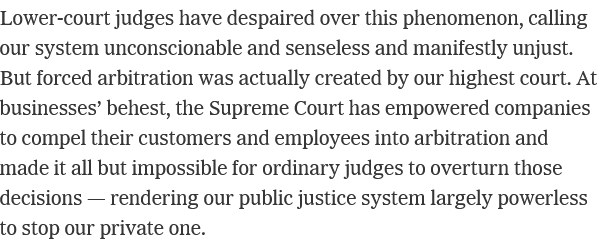
You may recall that a few weeks ago I wrote a post about private government, focusing on "private judges" and arbitration. The New York Times has a new essay about arbitration and private judging by Brendan Ballou, a former federal prosecutor. If you subscribe you can see it here. I recommend it. Here's a paragraph:
Comments ()