Wall Street Comes to Fayette
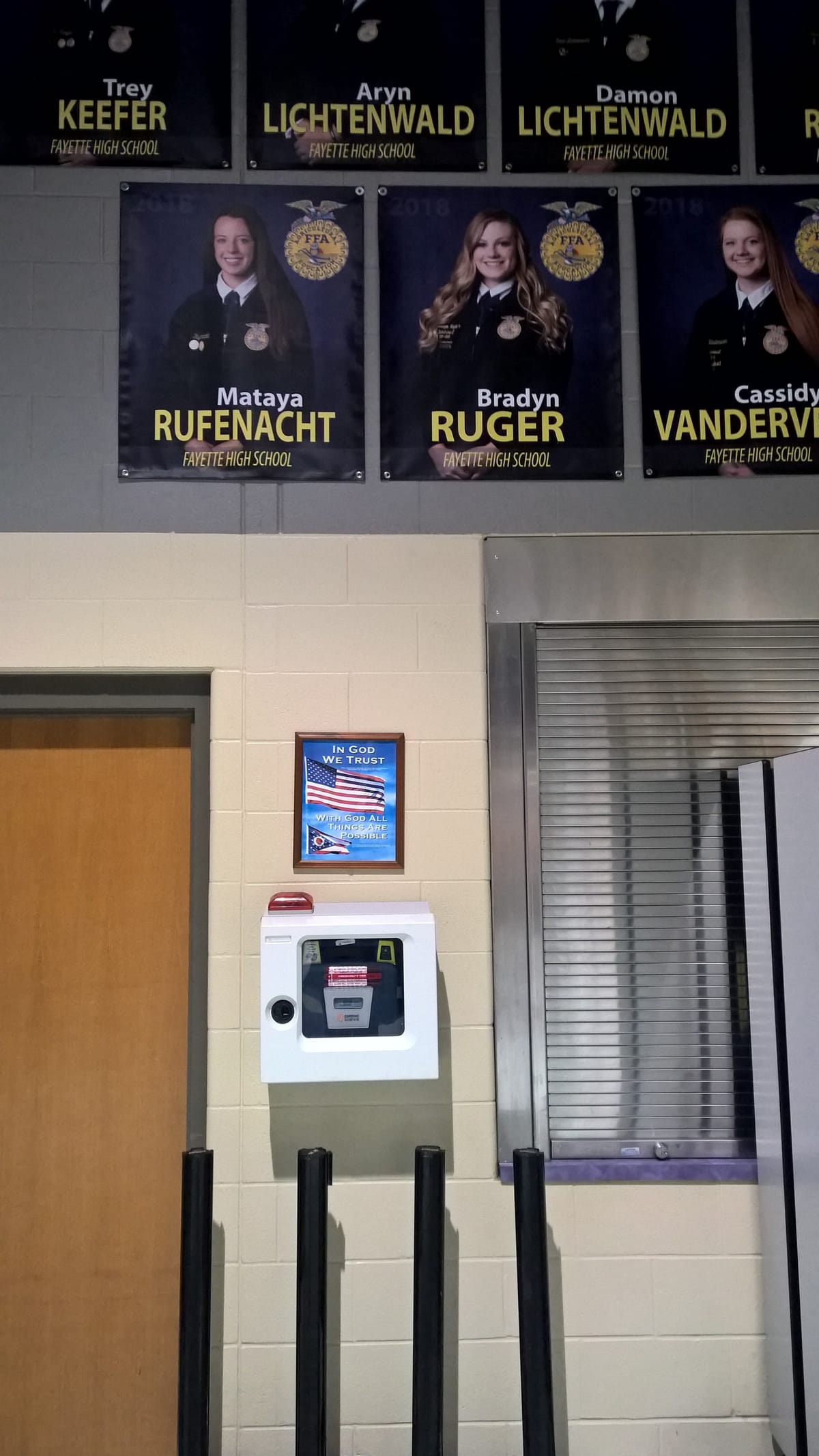
There was news this week about Donald Trump releasing a plan for health care in America. In West Virginia, the governor, Patrick Morrisey, talked about health care in his first state of the state address. Meanwhile, the U.S. Congress is struggling to save what's left of Obamacare, and people all over the country are furious over the actions of ICE in Minneapolis, most especially what looks like the murder of a woman by an ICE agent and the subsequent lies of the president, vice-president and their enablers in Congress and media about said woman, and while all these things can seem unrelated, what if they're not?
The photo above is from the gym of Fayette High School in Fayette, Ohio, a village of about 1,300 people in Fulton County, in the northwest corner of the state. It's the kind of place where kids in Future Farmers of America get their pictures posted in a place of honor, right above a religious message encouraging a belief in a god (presumably a Christian version). That message might violate the First Amendment, but nobody in Fayette is about to make a fuss about that.
People do farm in Fulton County, but the largest taxpayer in Fayette is, or was, Eagle Machining. It made machined parts, mostly for the auto industry. On December 29, the company informed the state of Ohio that it was shutting down and firing 251 people. In response to the loss of tax revenue, last week, Fayette laid off most of its police force, including the chief. It will now have one full-time officer.
Eagle machining is part of First Brands Group. You've probably never heard of First Brands Group. This is it:

One of those little gray boxes, to the right hand side of the middle of the image, is Eagle Machining. The other little boxes are other companies, including some you have probably heard of, like Fram and Autolite.
How a corporate structure gets to look like that is a complicated story, and I have learned over the years that readers don't share my nerdy need to know all the complications. ("Complicated" happens for a reason – often more than one reason – and usually the purpose is obscurity. These things can be hard to follow because they are designed to be hard to follow.) Simmered down to a thick reduction, First Brands got to look like this because Wall Street lenders kept shoveling money to a man named Patrick James, CEO of First Brands, who used billions – eventually about $6 billion – in loans to buy up lots of auto suppliers and some very big houses and fancy cars for himself.
The bulk of those loan deals were part of "private financing." Private financing is a lot like payday lending for corporations. Lenders can charge high interest rates in return for giving money to outfits with sketchy credit. Some big Wall Street players were involved with building up First Brands: Jefferies, UBS, Cantor Fitzgerald (which made a deal to buy the part of UBS that loaned First Brands money. Howard Lutnick, Trump's secretary of commerce, was the long-time CEO and chairman of Cantor Fitzgerald.). Others joined the party, too.
First Brands collapsed last fall under all that debt, and, lenders argue, fraud. It declared bankruptcy. The whole thing is a giant mess and lawyers are going to reap many billable hours at $1,750 per hour duking it out in court. Years will go by.
But Eagle Machining in Fayette will still be closed. So will the Dalton Corp foundry in Warsaw, Indiana, established in 1910. So will will Eagle Castings in Hanover, Pennsylvania. That's about 600 people between those three plants alone. To small places like Fayette, Warsaw and Hanover these are catastrophic.
So, what does any of this have to do with health, or politics?
First, rich people, on average, live longer than poor people, by more than a decade. Poor and working class people live less healthy lives. This is why, as money has flowed to the top of the American pyramid, American life expectancy has fallen compared to our peer nations. Fayette, Warsaw and Hanover have lower median household incomes than the U.S. as a whole. Ohio ranks 39th out of 50 states and the District of Columbia for life expectancy. Indiana ranks 40th. Pennsylvania is in the middle at 24th.
West Virginia ranks dead last at 51st.
In his state of the state address, Morrisey insisted that “For generations, poor health has fueled an economic decline, which has in turn, worsened our state’s health outcomes.” But it's exactly the opposite. Economic decline and educational decline fuel poor health. The first coal mine opened in West Virginia in 1810 and, ever since, the state has been a paradise of extraction, and, ever since, the state has been poor. Morrisey offered a familiar solution: tax cuts. And more coal mining.
The local press coverage of the plant closures in Fayette, Warsaw and Hanover didn't delve into the First Brands bankruptcy and the real reasons why people were thrown out of work. In its notice of the Fayette closure to the state of Ohio, First Brands blamed the plant and its union employees: "the Facility has been underperforming for the past year, causing a strain on the Company’s liquidity and increasing the Company’s capital need. Even with additional capital, the cost structure for the Facility does not support keeping this Facility in operation."
But it's twenty-first century American capitalism that's to blame. Most people in Fayette, though, don't read Bloomberg or the Wall Street Journal. When you've lost your job, when you're not feeling well, when your community is suffering and laying off the police force, when you look around and know that smarty-pants people are, somehow, making a lot of money, you can become pretty resentful. You can start to look for somebody to blame, like, say, immigrants, college professors, liberals. All three of the counties where Fayette, Warsaw and Hanover are located voted heavily for Trump. They might be willing to start looking for answers elsewhere, now, if somebody's there to provide them.
Comments ()