The Shame of JD Vance
Vance has made himself an avatar for the moral and ethical vacuum at the heart of American government. He's not worthy to play Bingo at a parish fund raiser.
Lots of things about JD Vance offend me. He's an extraordinarily offensive person, full of glib smugness, so I'd rather not think of him at all. But his recent book, Communion, and his publicity tour for said book, has forced me to say something that has a much larger relevance than just dinging Vance's phony piety.
From the day it was published, my book Glass House was compared to Hillbilly Elegy, Vance's wildly successful attempt to throw Appalachians under the bus in the name of his own self-aggrandizement. In my view, Glass House was nothing like Elegy, but I kept getting asked about it, over and over. Realizing that Elegy sold about a zillion copies, and made Vance rich, I figured that slamming it would reek of envy. So I hedged by developing a stock answer. "It's an affecting family story," I said, "but I disagree with the politics" (and this was when Vance was still in his I'm-a-reasonable-Republican stage of career ladder climbing).
I am not proud of this fudging.
Then I received an email from Vance. He wanted to know about private equity. We exchanged a couple of emails which amounted to me trying to explain how PE firms can still make a lot of money even if they drive their takeover target companies into bankruptcy. None of it made sense to Vance.
Time passed and Vance became the chameleon of American politics, changing his colors from one month to the next. He's now the vice-president, Trump's man, which is fitting because Vance is a man without honor.
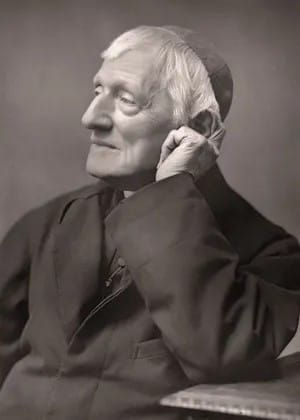
Have a look at the photo at the top of this page. That's John Henry Cardinal Newman. I spent a lot of time in college reading and studying Newman's book, Apologia pro Vita Sua (Defense of My Life is one way to translate that) as part of a tutorial on the writings of Victorian intellectuals. Newman is most famous for getting into an intellectual brawl with writer Charles Kingsley (author of The Water Babies). Newman committed the horrible sin (in Kingsley's eyes) of converting from Anglicanism, the Church of England, in which Newman was a prelate), to Roman Catholicism. He'd become a papist!
Picture a fight between Ali and Frazier, except this one was fought with pens in the pages of popular periodicals. Newman won an embarrassing victory, and the upshot of all that writing was turned into Newman's opus, the Apologia.
Because I was raised Catholic, spent seventeen years in Catholic education – all the way through university – tied for the altar boy attendance record at St. Mary's church, won the religion award at my high school graduation, but had been a doubter since seventh grade, Catholicism has always been a sort of hobby. I know a little about it.
So when Vance publicly announced his own conversion to Catholicism, I was pretty skeptical, especially because he seemed to be aligning himself with the "trad" Catholic factions that believe the church went astray at Vatican II. Trad Catholics want to fight culture wars.
Now he has come out with Communion, clearly a play to write a presidential campaign book. Reviews of the book are almost uniformly terrible, including in the Catholic press. You can look for those if you want. Instead, I want to talk about his apparent stab at likening himself to Newman, the parallel Vance seems to want to draw between his conversion and Newman's Apologia.
While I don't subscribe to Newman's religious views, I've been fascinated with him since that college tutorial. He was a brave and honorable man. He was also an intellectual giant. This is why there are Newman centers on college campuses all over America. This is why the church named him a saint.
The contrast with Vance could not be starker. Think of Trump and Vance as you read:
"To one other authority I appeal on this subject," Newman wrote in the Apologia, "which commands from me attention of a special kind, for it is the teaching of a Father. It will serve to bring my work to a conclusion.
"'St. Philip,' says the Roman Oratorian who wrote his Life, 'had a particular dislike of affectation both in himself and others, in speaking, in dressing, or in any thing else.
"'He avoided all ceremony which savoured of worldly compliment, and always showed himself a great stickler for Christian simplicity in every thing; so that, when he had to deal with men of worldly prudence, he did not very readily accommodate himself to them.
"'And he avoided, as much as possible, having any thing to do with two-faced persons, who did not go simply and straightforwardly to work in their transactions.
"'As for liars, he could not endure them, and he was continually reminding his spiritual children, to avoid them as they would a pestilence.'"
Vance's servile own accommodation to Trump, the ultimate sociopathic liar, a man who breathes sycophantic praise like oxygen, a criminal, a sexual assaulter, is hardly the example of piety Newman valued.
And what of Vance's own lies? He defamed an entire group of people, Haitian immigrants, by accusing them of capturing, cooking, and eating their neighbors' dogs and cats even though he knew this was a lie. I could give you a long list of Vance infamy, from Ukraine, to Canada, to Greenland, but this one alone should suffice.
"The Catechism of the Council of Trent," Newman continued, "was drawn up for the express purpose of providing preachers with subjects for their Sermons; and, as my whole work has been a defence of myself, I may here say that I rarely preach a Sermon, but I go to this beautiful and complete Catechism to get both my matter and my doctrine. There we find the following notices about the duty of Veracity:—
"''Thou shalt not bear false witness,' &c.: let attention be drawn to two laws contained in this commandment:—the one, forbidding false witness; the other bidding, that removing all pretence and deceits, we should measure our words and deeds by simple truth, as the Apostle admonished the Ephesians of that duty in these words: 'Doing truth in charity, let us grow in Him through all things.''"
Then, Newman wrote, as a rule for Catholics: "Nothing is more necessary [for us] than truth of testimony, in those things, which we neither know ourselves, nor can allowably be ignorant of, on which point there is extant that maxim of St. Augustine's: 'Whoso conceals the truth, and whoso puts forth a lie, each is guilty; the one because he is not willing to do a service, the other because he has a wish to do a mischief.'"
Vance has made himself an avatar for the moral and ethical vacuum at the heart of American government. He's not worthy to play Bingo at a parish fund raiser.
Comments ()