Springfield and Minneapolis Echo.
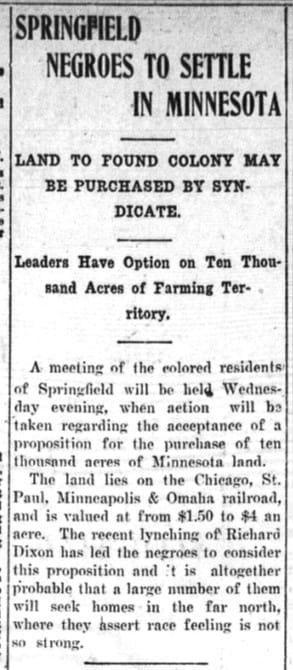
See the newspaper clipping, above? That comes from the Lancaster, Ohio Eagle, later known as the Lancaster Eagle-Gazette, my hometown newspaper where my first attempts at journalism were published. (I was a high school kid, editor of the school paper, the William V. Fisher Catholic Irish Pen, which was published in the E-G.)
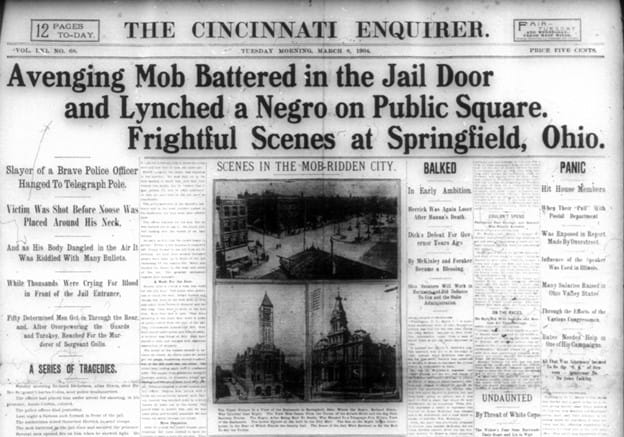
In 1904, a Black man named Richard Dixon was lynched in Springfield, Ohio, a city situated between Columbus and Dayton. The trouble started as a domestic dispute. Dixon argued with his common law wife. He called on a police officer. Exactly what happened next is doomed to remain murky, but Dixon was accused of shooting both the wife and the officer. He was taken to jail.
A mob of whites gathered around the jail. Springfield had a National Anti Mob and Lynch-Law Association, and it sprang into action, along with Dixon's lawyer, a Black man named Sully Jaymes. He'd opened his law office just the year before to become the first Black attorney in the city. Jaymes offered his services free of charge if a client couldn't pay, because, the way he saw it, Black people, even north of the Mason-Dixon line, were too often denied justice, in part because they couldn't pay for it.
The Anti Mob and Lynch-Law Association, and Jaymes, warned officials that things were going to turn violent, but not much was done to protect the jail nor Dixon. The mob of hundreds broke into the jail, took Dixon, and shot him dead in the jail yard.
Still not satisfied, they tied a rope around Dixon's neck, dragged him through the streets, strung him up on a telegraph pole "and drew the body about eighteen feet above the street," reported the New York Times. "They then descended, and their work was greeted with a cheer. A fusillade then began, and for thirty minutes the body was kept swaying back and forth from the force of the rain of bullets which was poured into it. The mob went fairly wild with delight."
Then the mob started burning Black-owned businesses.
There was more race violence in Springfield in 1905, and again in 1921. "Late reports to the police were that fourteen negroes were shot in the battle between whites and negroes in that area," the Times wrote of the 1921 violence.
After the 1904 riot, Black people considered moving away, and some did. As the clipping above indicates, they formed a syndicate to buy land in Minnesota "where they assert race feeling is not so strong."
You'll likely recall Springfield as the city where JD Vance claimed that immigrants from Haiti were eating people's pets. This was a lie and Vance knew it was a lie. "If I have to create stories so that the American media actually pays attention to the suffering of the American people, then that’s what I’m going to do," he said.
Vance tried to stoke race hatred. His strategy worked on some people, despite the efforts of Springfield's mayor and many of its residents to defend the honor of the immigrants and explain the value those immigrants brought to the city. The threats and intimidation arrived, just as Vance intended.
Vance was, in a modern sense, trying to lynch Black immigrants.
This is what is happening now, in Minnesota, where some of Springfield's Black people migrated seeking a safer haven after the violence of the early 1900s. Somalis are the ones being targeted now, though it seems just about any non-white person could be picked up off the streets by agents of ICE.
Yet the thinking of those Black people in Springfield who sought refuge in Minnesota is being vindicated every day on the streets of Minneapolis and elsewhere in the state as people of all colors band together, as a community, to protect their fellow neighbors. There is a program to foster division and hatred afoot in the nation as a means to instill fear, but the people of Minnesota, unlike the mob in Springfield a century ago, are refusing to play along.
Comments ()