Socialism for Whom?
The whole idea of bestowing socialism on corporations while forcing everybody else to engage in cutthroat capitalism has backfired over and over.

Unless you're the kind of person who pays close attention to such things, or you live in Iowa, you may have missed news of one of the biggest corporate giveaways in American history, and easily the biggest in the state of Iowa.
A week ago last Friday, October 2, the Iowa legislature, called into special session by governor Kim Reynolds, passed a package of tax breaks for an Indian conglomerate named Essar Group, run by one of India's richest, most politically connected, families. Essar's Mesabi Metallics division says it's going to build a $15 billion steel mill in Lee County. Mesabi claims it will build the mill, employ lots of people, and ship ore from a mine it hopes to operate in Minnesota's Iron Range, about 250 miles away, to stock it.
Iowa is giving Mesabi about $1.4 billion for the new mill. That equates to about $820,000 for every permanent job the company claims it will create.
Lee County sits in the southeast corner of Iowa on the Mississippi River, so all those jobs might not go to Iowans. People from Illinois and Missouri could easily drive there.
This is as much a political as an economic move. Donald Trump announced the bargain from the Oval Office, and Governor Reynolds pushed it through the legislature because there's an election coming up. Trump claims he has single-handedly revived manufacturing in this country, but that's a lie. As of the first half of 2026, more than 75,000 manufacturing jobs have been lost. So the Trump Party needs to show it's doing something, even if it means giving a huge handout to Indian billionaires.
There are many reasons to doubt the project. First, Mesabi's insistence it will ship the ore 250 miles from Minnesota – by river or rail; it says it hasn't decided – is, literally, an expensive stretch. The mine has not yet started full-scale operations. Second, Essar and Mesabi have a checkered history. The state of Minnesota tried to ban Essar and Mesabi from doing business there, accusing Mesabi of fraud. It filed for bankruptcy in 2016. Essar Group does business, including taking loans, from Russian bank VTB, which is under sanctions from the European Union following Russia's invasion of Ukraine.
But there is a bigger problem that's not limited to Iowa or this particular project that was expressed to me some years ago by a former state legislator in Ohio. He was a Republican who considered himself pro-business. But states, he said, found themselves trapped in a sprint to the bottom in their efforts to attract Big Business. Southern states started with "right-to-work" laws, anti-union legislation that made it difficult for workers to unionize, and so those states got auto plants and textile mills, and employees were paid less. Other states followed in those footsteps, and then started piling on tax breaks, incentives, "opportunity zones," sweet real estate deals.
Meanwhile, state and local budgets were being starved, in part thanks to all the giveaways, and in part because of America's anti-taxation zeal post 1980. So public goods suffered. Here's how the mix of university revenue in Iowa changed.
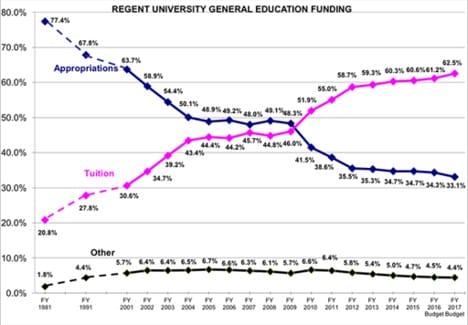
As the legislature cut public funding, tuition costs went up. Regular Iowans now have to pay much more to attend their public state universities, but Indian billionaires are being given the biggest handout in state history. Meanwhile, Iowa public schools are cutting programs, shuttering schools, and laying off teachers. Iowa City, for example, is looking to cut almost $14 million.
This is exactly the sort of scenario that worried the former Ohio legislator. He'd been a member of an outfit called ALEC, the American Legislative Exchange Council, an organization funded by conservative financiers Charles and David Koch. ALEC agitates for just this kind of no-tax, or low-tax environment, the dismantling of regulation, and business incentives. It writes model laws that have been introduced, and passed, around the country.
My Republican acquaintance eventually quit ALEC as Ohio became a leader in robbing average taxpayers to pay off Big Business. The state, which runs liquor stores, took the taxes people paid to buy booze, handed it over to the privatized outfit called JobsOhio, and let JobsOhio run the state's economic development. Much of what JobsOhio does has been opaque thanks to its privatized nature, but it has been rocked by scandal after scandal. None of that has stopped it from handing out billions of dollars to some of the richest people in the world. It gave $452 million to Anduril, founded by oligarch Palmer Luckey, an ardent Trump supporter, Peter Thiel acolyte, doubter of the value of democracy, and new advisor to Pete Hegseth's Pentagon. It also gave money to the paramour of Ohio State president Ted Carter, a scandal that led to Carter's resignation.
The whole idea of bestowing socialism on corporations while forcing everybody else to engage in cutthroat capitalism has backfired over and over. Remember Foxconn? As the journal for Strong Towns put it: "Wisconsin offered a $3 billion dollar subsidy to Foxconn and were promised a $10 billion factory and 13,000 jobs in exchange. Instead, the locals got three empty buildings, a few hundred jobs, and a mountain of debt." In Licking County Ohio, there's a giant, partially built campus for Intel, supported by state and federal giveaways. It was supposed to be making silicon wafers by now. Just last week, Intel said that it might finish that campus in the 2030s.
Such short term-ism is killing this country. There are better ways to attract business than bribing it: Education. Environment. Quality of life. Good transportation. Fairly priced power. All these, however, require investments for the public good. It's long-term thinking.
One of the smartest people I've ever encountered who works in this realm is a fellow named Tim Bartik, of the Upjohn Institute in Michigan. He has articulated a philosophy of "place-based policy." Here's a link to his ideas. As I read them, they boil down to using what you've got, not trying to be all things to all possible employers, shrinking the giveaways, and paying attention to the people who already live in your communities. Makes sense to me.
Here are a few good stories from local reporters around the country:
Comments ()