Private v. Public
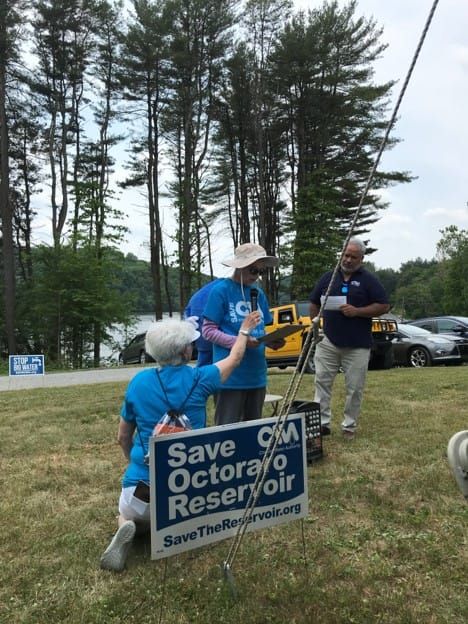
The people in that photo above, with the gray hair and the dad pants? They stood up, fought back, and, so far, they've won.
Last week, the Trump government announced that it would put Ohio's only national forest, the Wayne National Forest, on the sales block for fracking operations. That's right, oil and gas drillers will bid on the rights to drill holes into nearly 3,000 acres, pump hazardous fracking fluid into those holes, extract the gas and oil, if any, and then... well, the "and then" is always kind of an open question when comes to fracking as anybody who lives in the hills and hollows in Appalachia can tell you, because there are tens of thousands of derelict wells in the region, many leaking methane, poisoning the land, making people sick.
Here's a link to a New York Times story that ran this past week about what's happening now to Marietta, on the Ohio River, thanks to fracking waste migrating underground.
Nobody in Ohio was shocked by the announcement of leasing out the national forest land because the state government, in its wisdom, has already mandated that agencies that are supposed to protect the state's parks – and Ohio has some beautiful state parks – must approve fracking leases in state parks.
Have a look at the photo, above. That was taken several years ago in southeast Pennsylvania at a protest by organized by the Chester Water Authority, and area citizens and water customers, against the sale of the authority, a public water system serving the city of Chester and two suburban counties, to a giant utility. All over Pennsylvania, like other states, big utility companies are trying to buy up water and wastewater systems to take them private. Pennsylvania even passed a law, Act 12, to make it easier for the corporations to do so. You'll read more about this, and the fight over the Chester Water Authority in The Mayor (available for pre-order!).
A nun at this rally by the reservoir stood up to the microphone you see there and declared that profiting from the sale of water, necessary to life, was a sin. She could not understand how such a thing was possible to say nothing of how the state of Pennsylvania was actually encouraging it.
But this is where we are now. The forty years of free market worship, of the free market as the answer to all our needs, has become so ingrained that selling the peoples' water to a corporation has come to seem like a reasonable thing to do.
And so we are selling our public schools in the form of vouchers and charters, as I wrote about in this post. We are selling our highways, our parking meters, even our airport security.
The subject of privatization has been a big bugbear for me for a long time. Here's a story I wrote for The Atlantic a few years ago. (Yikes. Almost a decade.)
But I was prompted to write about it this week because of something I read about space. It's a New York Times story about the oligarchs, including the usual suspects like Musk and Bezos, trying to grab parts of the radio spectrum, which belongs to everyone, for themselves. Perhaps coincidentally, there was another story about all those satellites orbiting over our heads, and how they come crashing down to Earth, and how they could hit your house and kill you, and how nobody seems to be responsible for any of the damage.
All these things – parking meters in Chicago, water in Chester, gas wells in Appalachia, school vouchers in West Virginia, a privatized highway in California, and the space above our heads have more in common that might first be apparent. They are all part of our common wealth as citizens in the United States, and, at least for space, residents on earth. They belong to us, and should be managed for all.
A corporation is a profit-seeking entity. It's mission, nay, it's duty, is to seek profit for its shareholders. It is not responsible for the common wealth. The United Kingdom found this out when it privatized water. Thames Water, the huge utility that took over much of Britain's public water, is a failure in every way that matters.
Now, America's power supplies are teetering under the weight of massive data center building by private enterprise. There are people now in West Virginia who are taking out loans to pay their electricity bills. In this century, electricity is as necessary to life as water, and, I would argue, profiting from it is a sin, too.
But, free marketeers might argue, it was the free market that built up the power grid and provided the conveniences and lifestyle and benefits we enjoy today. And they'd be right, partly, but only partly.
There is no utility free market. Utilities have a government-granted monopoly, and not only do they enjoy a monopoly, but they are guaranteed a profit by the government. Every power pole, every power line, every generator an electric company invests in, it bills at cost plus, meaning they recover the cost plus 7 percent or 10 percent, or whatever a state's public utilities commission allows. And PUCs are notorious for being captured by industry via revolving doors between power companies and utilities.
Now imagine this scenario spread out to schools, water, roads, radio and television, and anything else you can think of.
This is the agenda. And it is not an agenda to help the mass of citizens, it is an agenda to make rich people even richer. It is not the purpose for a company to look out for you. And so it won't.
You could acquiesce to having your life run by CEOs and the Musks and Bezoses of the world. Or you could take back what belongs to you and all of us. The people in that photo above, with the gray hair and the dad pants? They stood up, fought back, and, so far, they've won.
Comments ()