Manly Men, Meaning, and the Modern Project (Part II)

Have a look at the photo above. I took that in 2015 or 2016 in the showroom of what was comically called Everyware Global, but what every single person in Lancaster, Ohio called Anchor Hocking. Everyware Global was a private equity creation, a mashup of two venerable brands, Anchor Hocking Glass and Oneida, the silverware people in upstate New York. I wrote about how all that happened and what effect it had on the town, in my book, Glass House: The 1% Economy and the Shattering of the All-American Town.
Please think about that name for a moment: Everyware Global. It is both redundant – everywhere pretty much covers global – and a bad play on "ware" which is what glassmen call the stuff they make – the glasses, baking dishes, and measuring cups and Oneida's dinner ware. Even worse, the made-up name was free of meaning. Both Lancaster and Oneida had rich histories, as places and as communities, and people attached much value to that history, both the history of the places themselves, and to the work traditions. There was honor and pride in it. There was identity. PE guys stripped all that away, not just with a cockamamie name – everywhere also meant nowhere – but also the financial engineering and the offshoring that led to an "Oneida" product being made in China.
Last week, in Part I of this essay, I discussed work, and manliness, and dignity, and how Pete Hegseth, who has none of those qualities, is a kind of avatar for what I think is something big that's happened to us and our culture. To help explain this, I would like to introduce you to Ulrich Beck.
Beck was a renowned German sociologist. I was reporting Glass House at the time of his 2015 death. I can't recall how I ran across the news, but I did, and when I read more about him, and his writing and theories, I thought I'd accidentally found academic, theoretical confirmation of some things I'd been thinking myself after living back in Lancaster and talking to lots of people there.
In 1986 Beck wrote a book called Risikogesellschaft, or, when it was published in English six years later, Risk Society: Towards a New Modernity. He described his concept of the risk society in a 2013 interview with the London School of Economics. "To me the risk society is a situation in which we are not able to cope with the uncertainty and consequences that we produce in society."
Beck described a "first modernity" which he believed began during the 18th Century and lasted until the late 1970s. It was, he said, "a period where there was a great deal of space for experimentation and we had a lot of answers for the uncertainties that we produced... But then because of the success of modernity we are now producing consequences for which we don’t have any answers, such as climate change and the financial crisis." This is the "second modernity."
As I understand Beck, he argued that the neoliberal religion, the elevation of "the market" above all, left the world unable to cope when the market failed. The superstructure of society eroded, strictures seemed malleable or no longer valid, and so nations, communities, individuals were set adrift. Others were victimized by the market, left to carry the fallout from the risks taken while some could use cash to insulate themselves from those risks. I saw this every day while living and working in Chester, Pennsylvania for my new book, The Mayor. (Shameless plug: It's available for pre-order. May I suggest your local indie bookstore, or Bookshop?)
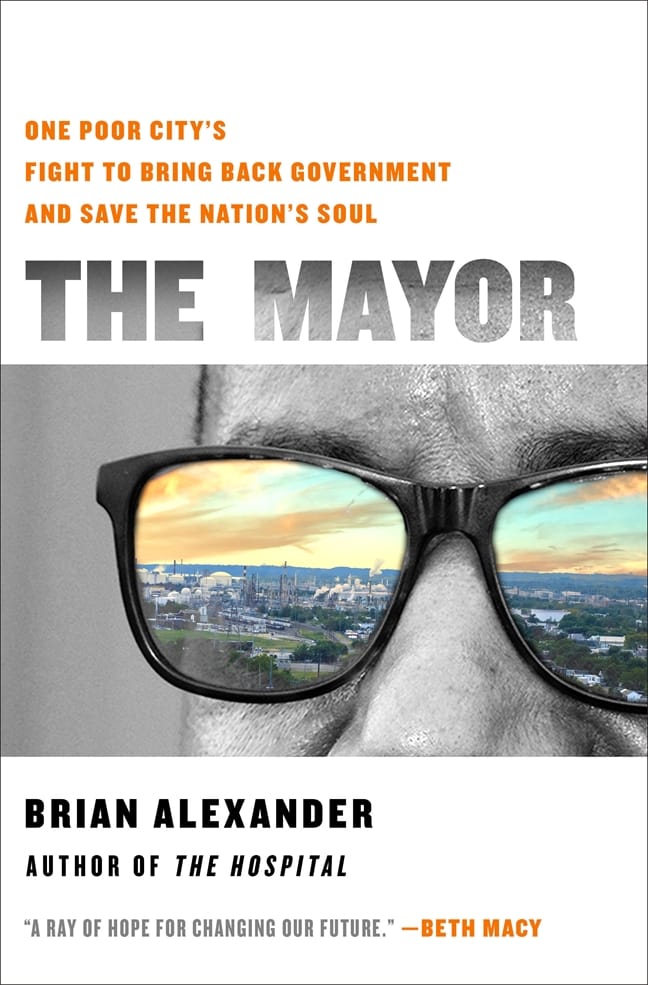
Chester has been the recipient of the fallout from unfettered market capitalism. This is true in the most literal sense, as I wrote in a post about the giant trash incinerator located on Chester's Delaware River waterfront. Meanwhile, other people in other communities, some just several miles away, live in a very different universe of safety and security.
Beck was prescient in his belief that the risk society would spread to everyone, eventually. And so it has. As he mentioned, climate change is the most obvious example; there is no escaping it no matter how much money you have. But I think, and I think Beck would agree, that we have also lived through a moral breakdown that has affected everybody, rich or poor. Nihilism and cynicism have replaced faith and community.
I am not talking about religious faith, though I'll get to that in a moment. Rather, I am talking about faith in each other, faith in government, faith in the American narrative, and the understanding that we are members of communities and, as such, owe some duties to each other.
I was first attracted to Beck when I read some of his thinking on labor and the meaning of work, because I was talking to a lot of people, mostly men, who had lost, or were barely hanging onto, their sense of themselves. In America, and surely in other countries, too, you are what you do. Or at least that was often the way it was. When I use the term "glassman" to indicate somebody who works in a glass factory, for example, that's a kind of honorific. You earn that title just as somebody with "PhD" behind their name, or "Esquire," or "MD" earns theirs. We see the early forms of this in many guild-derived names, like Shoemaker, Miller, Turner, Baker.
As Beck wrote in Brave New World of Work, "the extent to which work is part of the modern European's [and American's] moral being and self-image is evident from the fact that, in Western culture, it has long been the only relevant source and the only valid measure for the evaluation of human beings and their activities...."
During Beck's "first modernity," there were fights, sometimes bloody ones, over the meaning and dignity of work. In the new industrial age, workers were often as disposable as widgets and treated like widgets. The early unionization battles, muckraking journalists, the New Deal, and finally the remade social order of the post-World War II era helped re-establish meaning and dignity, though some battles continued; the tension between capital and labor is never-ending. As Beck explained in his book What Is Globalization? The workers' movements of the late 19th and early 20th Centuries "acted as a countervailing power."
Since the late 1970s until today, though, "global enterprises have for a long time not been challenged by any other (transnational) power." The free-market cult "permits employers and their associations to disentangle and recapture their power to act that was restrained by the political and welfare institutions of democratically organized capitalism.... It means that corporations, especially globally active ones, can play a key role in shaping not only the economy but society as whole."
"The global operation of the economy," Beck wrote, "is sapping the foundations of national economics and national states, unleashing subpolitics on a quite novel scale and with incalculable consequences."
The capacity of government to shape and control events has decayed as more and more power has shifted from government to business. Since people in democratically elected governments are the government ("of the people, by the people, and for the people" as Lincoln said at Gettysburg), the people have lost power.
Just today, as I have been working on this essay, Sam Altman of OpenAI, advocated "intelligence as a utility" to be purchased from his company, of course. Meanwhile, Alex Karp, CEO of the surveillance tech company Palantir, was reported to have purchased a $46-million mansion in Miami even as he declared, like Moses coming down from the mountain, that he and his fellow tech oligarchs were about to eliminate the jobs of many people.
"Why is it that we’re absorbing the risk of disrupting the very fabric of our society, including the most powerful parts of our society," Karp said, "if it’s not because it’s about maintaining our ability to be American in the near term and long term?"
Karp has no idea what it is to be an American. To him, America is an object of profit not a set of ideals and philosophies. It is not a narrative with meaning.
The "risk society" implications have already proved disastrous. As profit-seeking has become the only value, personal identities, regional identities, and national identities have been eroded. This could be said of the financialization of everything, as well as the globalization of everything.
After Bill Clinton forced NAFTA, the North American Free Trade Agreement, through approval at the behest of capital, "more exposed areas experienced larger increases in mortality," concluded a recent paper published by the National Bureau of Economic Research. "In the 15 years post-NAFTA, an area with average NAFTA exposure experienced an increase in annual, age-adjusted mortality of 0.68 percent (standard error = 0.19), an increase that more than erases prior estimates of the welfare gains from NAFTA’s nationwide economic benefits." This would not surprise Shannon Monnat, the Syracuse University sociologist who coined the term "deaths of despair" and has been studying such effects for years.
You can see this everywhere now, not just in old-school manufacturing towns like Lancaster and Oneida. In the December 8, 2025 issue of the New Yorker, writer John Seabrook wrote about "How the Sports Stadium Went Luxe." Stadiums were once a haven of democratic entertainment. Rich and poor could pay just a few bucks and sit shoulder to shoulder to enjoy a ball game. Not any more. The rich are cossetted in luxury suites with all sorts of special privileges they purchase. In this case the risks include aggravating the Velvet Rope Economy, thus increasing the sense of, and the reality of, our ever-more-unequal society. "Home team" has become meaningless and so has the city pride and identity once wrapped around teams. Imagine taking the Cubs out of Chicago. Well, right now, team owners are taking the Guardians (formerly the Indians) out of Cleveland to a new stadium, and Las Vegas is building a $1.5 billion stadium stuffed with luxury suites to house the Oakland A's. Both stadiums are being heavily subsidized with taxpayer dollars though the team owners are billionaires. And all so those owners can make more money by "monetizing" luxury access. "Left behind," Seabrook wrote, "were...tens of thousands of enraged A's fans, many with generational ties to the team."
The structures, the guardrails, the web of government and social norms that guided the social contract, the moral and ethical framework in which we lived, have come apart, sacrificed on the altar of money grabbing. They've been replaced by nihilism and cynicism, and AI is going to make all that much worse if we don't resist it.
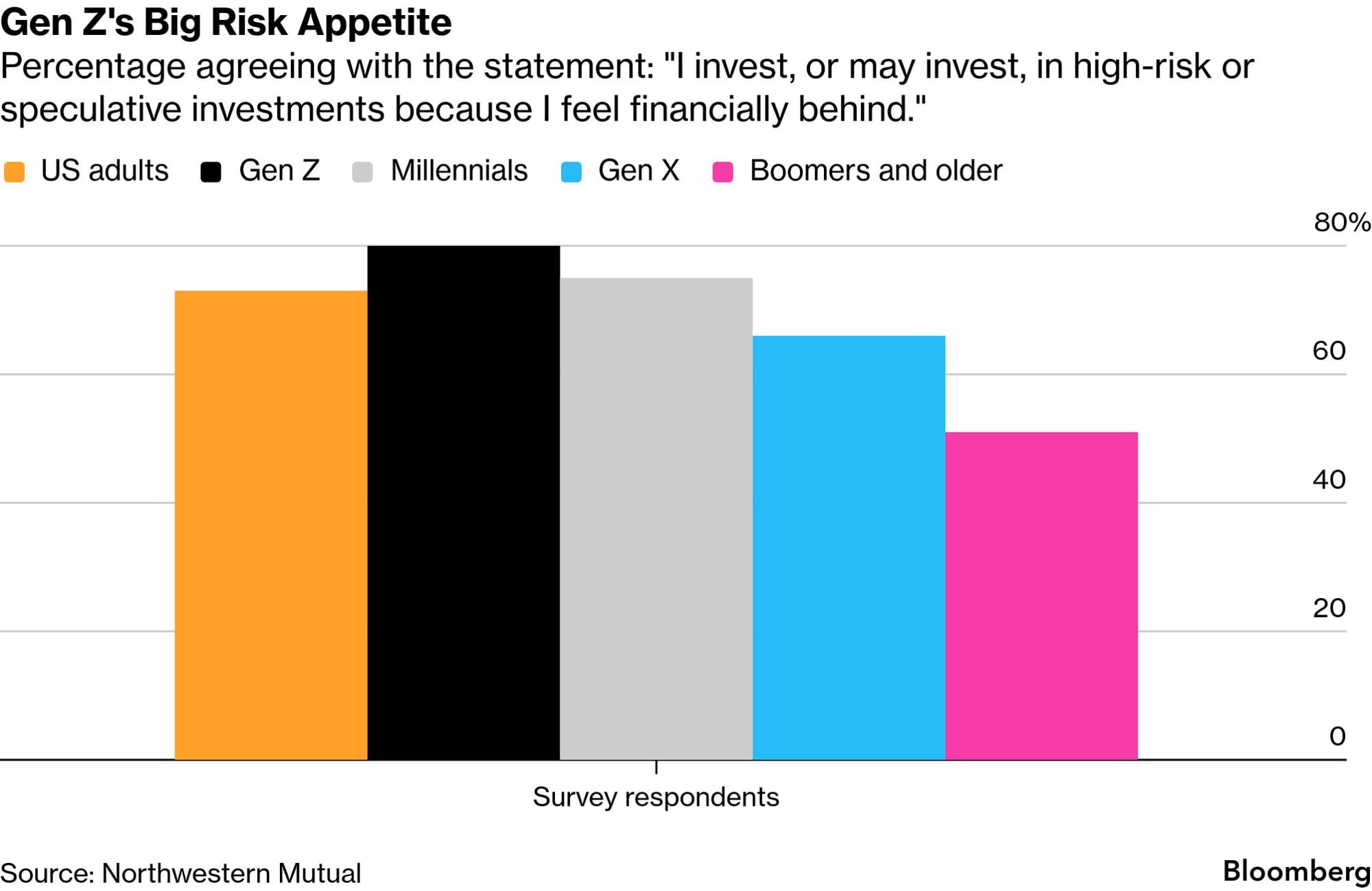
This is how we get universal gambling, crypto currency, meme coins, NFTs, FTX, Kalshi bets on killing people, Silicon Valley oligarchy, and fantasies of starting new libertarian "countries" where nobody owes any duty to anybody else. Many seek ways to compensate for their relative lack of cash with "financial nihilism." They don't want to be on the losing end of the risk society. Long-term building, the gradual accumulation of value, is for losers.
But here's the thing: human beings crave a narrative. We want our lives to be about something. Without an anchoring story and the moral and ethical lessons of the story, we are unmoored. Work means nothing other than a paycheck. Government means nothing other than keeping prices low or gaming it for profit the way billionaires squeeze tax dollars for stadiums. Religion means nothing other than how I can use it to make political hay. Kindness and community are for suckers.
As Beck wrote, it seems that "a society without work is a society without a center, a society lacking basic coordinates in matters both large and small, in everyday life as in politics, economics, the law and so on."
"The second modernity implies the disappearance of some of the basic principles that were to be protected and developed by modern institutions," he argued. "It is a question of the consequences of modernity’s victory which have called into question the foundations of the institutions."
Demagogues know that people crave a story, and an identity, and they are happy to step into the breach to exploit that need. They'll weave a story out of anger and hate as a means to power. This degraded story preaches power, money, fame, a phony manhood, an extreme nationalism. These become new sources of identity. Some people will cling to these the way Hegseth clings to his too-tight suits and his bullying, murderous rhetoric. Young men will cling to UFC fighters, and obnoxious peacocking and, sometimes, racism and nationalism.
As I understand Beck, he believed that we needed to rethink not just discrete policies or laws, not just a reform or two, we needed a whole new way to think about the world in which we live. We need a revolution.
That revolution has already begun, though I fear the leadership of the Democratic Party still fails to recognize it. (I am not a Democrat nor a Republican; I am one of many independents. But at the moment, I do not regard the Republican Party as a legitimate American political party.)
When Americans across the country metaphorically stood to applaud the people of Minneapolis who resisted ICE, that was a sign of the revolution. The brave people there were revivifying a great American story about community and neighborliness. Two people gave their lives for that story. When Zohran Mamdani was elected mayor of New York, that was a sign of the revolution.
I can tell you with some authority that in places like Chester, Pennsylvania, there is almost zero faith in political parties, period. That's part of the revolution, too. It will sweep away the old versions of the parties and take the think tanks and consultants with them.
In response to the "second modernity" Beck called for a kind of new cosmopolitanism, the opposite of Trumpism and America First and MAGA. Without sacrificing national or community identities, he called for more, and better international problem solving, a recognition that everything was now global and interdependent whether we wanted it to be or not. He called for new thinking about work. "Paid work is said to be disappearing," he wrote in Brave New World of Work, "but many think that in its place are appearing family work, parental work, ecologically purified work for the common good, or work that people really want to do." The European Union, for all its flaws, was an example Beck pointed to. France is still France, Germany still Germany, but greater cross-border problem solving has improved lives in Europe. You can see this now as Europe curbs the power of the Silicon Valley titans in ways the United States has failed to do.
He viewed such cosmopolitanism as a bulwark against autocracy. That's one reason, and I think an important reason, why you don't see Pete Hegseths running the militaries of our allies, and you won't see UFC fighters on the front lawns of government buildings.
Comments ()