Manly Men, Meaning, and the Modern Project (Part I)

After my dad graduated from Collinwood High School in Cleveland with grades so marginal that my grandmother blamed them on his pursuit of Betty Francis, the local "sweater girl" (look it up, kids), he went to work in the same tool and die outfit where my grandfather worked. He made seventeen cents an hour.
Two years later, the Japanese attacked Pearl Harbor, America entered World War II, and my father, having already received a 1A draft card, knew he'd be going sooner or later. So he joined the army. To fast forward this story, he met my mother, a lieutenant and therefore an officer, and through some petty corruption involving my mother's liquor ration, they broke the fraternization rules, romanced each other in tents pitched in a Normandy field, and returned to the U.S. engaged. This prompted my mother's father, a glassman since age twelve, to try to get my dad, now jobless, work in the glass business.
The high school grades not withstanding, my father was an intelligent man, especially about people. He had a gift for reading people, a kind of social intelligence. He was a born salesman.
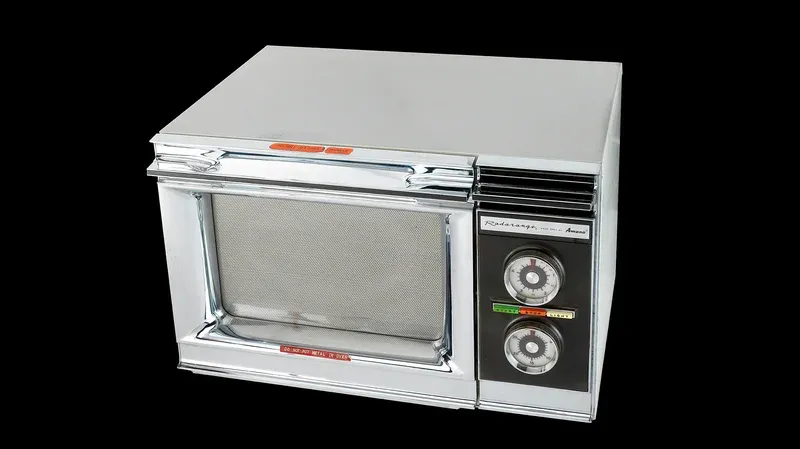
So fast forward again. My dad quit a job at Lancaster (Ohio) Glass, and hit the road as an independent manufacturer's rep. He sold stuff made by manufacturers to other manufacturers. Things were pretty tight for years, but he pulled it off, thanks, in part, to that social intelligence and, in part, to timing. I joke, though it's kind of true, that I got to go to college because just about everybody in America bought an Amana Radarange, the first commercial microwave oven, and my dad sold the glass panel that formed the window of the oven door.
He'd climb into his Chevy Impala on Monday morning, head off to Louisville, where GE had a huge Appliance Park; to Amana, Iowa; to Toledo and Mansfield, Ohio; to Sweetwater, Tennessee; to Detroit, Michigan. He was gone so much that I'm not sure how my parents managed to produce three sons, though, since we were each four years apart, my brothers speculated that my parents had sex every four years, to coincide with presidential elections. After what I suspect was some sort of spousal conversation about the importance of father-son relationships, dad started taking one or another of us on these multi-day sales trips to America's glamour spots. To cut down on expenses, we'd eat in cafeterias – I became a Salisbury steak aficionado – and stay in motels ranked just above "scary."
My father would pull up to a factory to call on a buyer, but he almost never entered through the front office door. He, and so whichever son was along for the ride, would walk around to a factory entrance, usually big rolling doors, and then across the plant floor. My father never forgot his time working on such a floor. He respected the metal press operators, the mold makers, the assembly workers. They were, in their way, professionals. Most of them were men, and it was important to my father that his sons knew what work looked like and how men worked.
Even as kids we were under no delusion that a factory was a workers' paradise. We did not doubt that some of these people hated their jobs. They weren't Santa's elves whistling while they worked. There is a risk, especially these days, of over romanticizing manufacturing. But many did like their jobs and the security and meaning the jobs provided. They could point to every Maytag washing machine and know they'd touched it. There was dignity in it that my father wanted his sons to see.
For the most part, these guys put their heads down, got to work, didn't brag, shot straight. To him, there was a kind of quietness about the kinds of men he admired as a leader, a boss, a buyer, a friend. You didn't pose or pretend. You were never a boor or a bully. You did not make crude remarks about women. And though my father could swear like a virtuoso – the man had at least a dozen variations of "goddammit" that implied a dozen different meanings depending upon volume, intonation, speed – I never, ever heard him utter the "F" word and never, ever heard him use a vulgarity for a woman's vagina.
He was a man of his time and not a saint. He was not a liberal. But he also respected women, including those with whom he worked.
One time when I was with him we called on a female buyer at GE. Her name was Fay. They'd worked together a long time by then, with Fay trying to jaw down a price, or complaining about a defect in a part, and my dad countering. I marveled at the back and forth. She was one of his favorite buyers because she viewed their relationship as a collaboration among colleagues. They had developed trust. He did not feel the least bit neutered by their interactions and not only did not resent having to defer to her, as the buyer, he thrived on it.
I don't know where he picked up this code, exactly. Maybe his father? Maybe the leaders of the army in which he served, like Eisenhower, or Omar Bradley? They were serious people with serious work to do and they seemed to hate the world of war though they were leading millions in a war. They didn't seem to view war as glory. It was an awful, wasteful thing even when it was just and necessary. Probably he picked up his ways from many sources.
I got mine from my father; though he wasn't around much his example was still powerful. I also got it from the older men I came to know, some of them friends of my father, and the friends I made along the way.
Last year, my best friend from childhood died. His name was Mike Messerly. Mike was a renowned physicist. He worked on optics and lasers and, at the time of his death from a glioblastoma he was working at Lawrence Livermore National Laboratory on nuclear fusion. (He once tried to explain tritium ice to me, and you now know everything I know about tritium ice.) Mike also helped quality check the optics on the James Webb Space Telescope. He was also a stud. His widow showed me a picture of him when he was in graduate school. A peasant woman could have done laundry on his abs. You would not know any of this unless you asked. He was modest to a fault.
A month or so before he died, I went for a visit, and my other best kidhood pal, Patrick, joined us. Patrick has his own remarkable resume that I can't tell you much about because he can't tell me much. Suffice to say that Patrick has done a lot of "government work." We caught up over beer and pizza, and my eyes grew wide as they told me about accomplishments I never knew all these years. In response they said things like "It wasn't that big a deal," or "I was a small part of it." They both treated their work the way the people on the factory floors treated theirs.
Mike and I took a walk. Though he had been an expert hiker, including through Yosemite and the Sierras, he now needed the aid of a walking stick. As we talked the way men almost never talk to each other, we spoke about how, as boys growing up together, we taught each other how to be men. We made mistakes. We did not always behave in ways we were proud of behaving. But we learned, and because we had each other, and Patrick, we managed to muddle our way until Mike and Patrick both became two of the nicest people I have ever known.
"Love you like a brother," I said.
"We are brothers," he said, which was saying something because Mike had twelve siblings and did not need another.
I am telling you all this because for years I have been thinking, and often writing, about modernity, community, labor, and the unmooring of meaning. My father, Mike and Patrick, the people my dad admired who worked in the plants, the leaders he respected, the men he chose for his friends, not only became who they became because of each other, or their own fathers, they became the men they were because they lived within a social and value structure that encouraged all this. I am not going to argue that all was well with that structure. Of course not. But they had a kind of faith in it. That faith promoted meaning and belonging.
Then, this past week, as the United States began dropping bombs on yet another country, I watched as Pete Hegseth spoke and behaved like an obnoxious 13-year-old boy playing a video game, full of braggadocio, strutting, triumphalism. About war. About people being killed. His was the least manly performance I have ever seen from a wannabe American leader because it was hollow. He reeked of insecurity, as if he knew he was wearing clothing far too big for a little boy frame, as if he knew he did not have the steel, the knowledge, the moral and ethical foundation to lead a nation into war. He's empty and so he fills the void with douchebaggery. He is far from alone in that.
In Part II of this post, I am going to discuss why I think Hegseth is a symptom of a culture-wide phenomenon that has to do with labor and work, belief, the loss of anchors, and the emptiness of our current cultural epoch, and how, at least in part, we wound up here. It'll also be about a brighter future, with a giant helping hand from a man name Ulrich Beck.
Will it make any sense? We'll see! Tune in to find out if I can pull it off.
Comments ()