Gilded Age: A Tale of To-Day
Last week there was a lot of talk about the Gilded Age and Trump's State of the Union declaration that he has ushered in a new "Golden Age" of America. The Gilded Age, in fact, has been discussed a lot in recent years, often in the context of America's outrageous inequality and often prefaced with introductory phrases like "Not since the Gilded Age..."
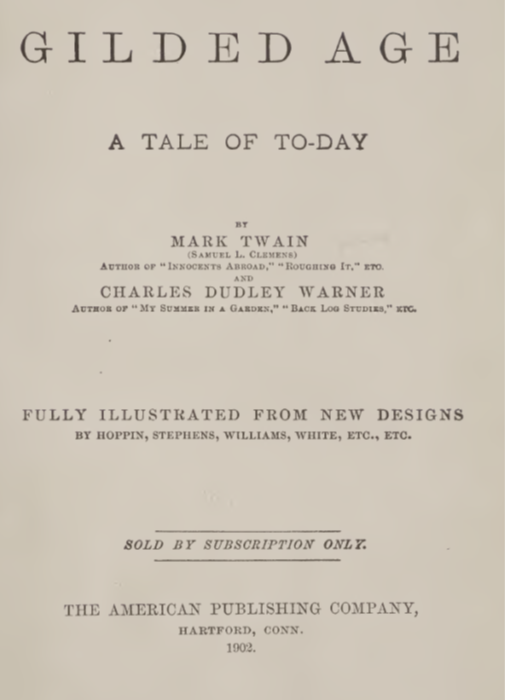
The blizzard of references can obscure the roots of the term and what it originally signified. Digging under all that snow reveals just how uncannily the term applies to this moment in American history. The term comes from Gilded Age: A Tale of To-Day, a book written by Mark Twain and his friend, newspaperman Charles Dudley Warner. (Warner was so famous in his day that three consecutive streets in the Point Loma neighborhood of San Diego, where many streets are named for writers, are Charles, Dudley, and Warner.)
Lots of people know of the book, but many fewer have read it. The impression many have, thanks to all the modern-day references to it in the context of inequality, is that it's a kind of Edith Wharton tale about rich-people society. But that impression is belied by the word "gilded" in the title. Gilt is a phony cover up. Think of Trump's makeover of the Oval Office with all those faux gold classical urns and gilded picture frames, like a cheap New Orleans bordello from 1920, or Caesar's Palace in Las Vegas. What looks like gold is just a thin veneer covering up the cheapness. There is no solid foundation, no underlying moral, ethical, steadfastness. No meaning.
This is the real heart of Twain's and Warner's book. It's a scathing satire of America, originally published in 1873, that, within a few years, proved prescient not only for late 19th Century America, but for the early 21st, too. (That said, though it can be funny, insightful, and dark, it can also be a slog, and I write that as somebody who reveres Twain.)
"In a state where there is no fever of speculation," they wrote in the book's preface, "no inflamed desire for sudden wealth, where the poor are all simple-minded and contented, and the rich are all honest and generous, where society is in a condition of primitive purity and politics is the occupation of only the capable and the patriotic, there are necessarily no materials for such a history as we have constructed out of an ideal commonwealth." I could not help but think of crypto currency speculators.
The book's narrative hangs on the trials of the Hawkins family whose patriarch buys land in Tennessee that, he is convinced, will someday provide a vast fortune for himself, his wife, their children, and even if he doesn't live to see the day, then for his children, at least. As the years pass, and the family moves, but retains the land, there follow many get-rich schemes, often involving land speculation, but also, for example, "Beriah Sellers' Infallible Imperial Oriental Optic Liniment and Salvation for Sore Eyes – the Medical Wonder of the Age!"
Make America Healthy Again.
In the world of Gilded Age, America is fueled by flim-flammery. Wannabe operators puff themselves with hot air. "He frequently accompanied Henry part way down Broad Street, to which he went, or pretended to go, with regularity every day. It was evident to the most casual acquaintance that he was a man of affairs, and that his time was engrossed in the largest sort of operations, about which there was a mysterious air. His liability to be suddenly summoned to Washington, or Boston, or Montreal or even to Liverpool was always imminent. He never was so summoned, but none of his acquaintances would have been surprised to hear any day that he had gone to Panama or Peoria, or to hear from him that he had bought the Bank of Commerce."
Jeffery Epstein, anybody?
A young woman questions an investment scheme and the effect it might have on people who can ill-afford to lose their money. "'Well, what would become of the poor people who had been led to put their little money into the speculation, when you got out of it and left it half way?'" she asks a wheeler dealer named Bigler.
"It would be no more true to say of Mr. Bigler that he was or could be embarrassed, than to say that a brass counterfeit dollar-piece would change color when refused..."
Bigler insists that his profit-making is to society's benefit, just as Silicon Valley titans say their profit-making is good for us.
"'Why, yes, Miss, of course, in a great enterprise for the benefit of the community there will be little things occur, which, which – and of course, the poor ought to be looked to; I tell my wife, that the poor must be looked to; if you can tell who are poor – there's so many imposters.'"
I have heard private equity partners say almost these exact words.
Such schemes often require corruption. In this same conversation, Bigler explains that politicians are among the poor.
"'And then, there's so many poor in the legislature to be looked after,' said the contractor with a sort of chuckle, 'isn't that so, Mr. Bolton?'
"'Yes,' continued the public benefactor, 'an uncommon poor lot this year, uncommon. Consequently an expensive lot. The fact is, Mr. Bolton, that the price is raised so high on United States Senator now that it affects the whole market.'"
Wall Street comes in for Twain's and Warner's treatment. One passage in particular presages today's crisis in the "private credit" market, the subject of my post about little Lafayette, Ohio.
"Beautiful credit! The foundation of modern society. Who shall say that this is not the golden age of mutual trust, of unlimited reliance upon human promise? That is a peculiar condition of society which enables a whole nation to instantly recognize point and meaning in the familiar newspaper anecdote, which puts into the mouth of a distinguished speculator in lands and mines this remark: – 'I wasn't worth a cent two years ago, and now I owe two million dollars.'"
Financial engineers figure out ways to cheat laborers out of their pay. A senator is faced with charges of bribery. Politicians buy votes. Gambling takes over the financial markets.
Charity and religion are used as a cover.
"'And then there's your contributions, as a company, to Chicago fires and Boston fires, and orphan asylums, and all that sort of thing – head the list, you see, with the company's full name and a thousand dollars set opposite – great card, sir – one of the finest advertisements in the world...Perhaps the biggest thing we've done in the advertising line was to get an officer of the U.S. government, of perfectly Himmalayan [sic] official altitude, to write up our little internal improvement for a religious paper of enormous circulation – I tell you that makes our bonds go handsomely among the pious poor...and if it's got a few Scripture quotations in it, and some temperance platitudes and a bit of gush here and there about Sunday Schools, and a sentimental snuffle now and then about 'God's precious ones, the honest hard-handed poor,' it works the nation like a charm."
In their book, America is covered in a thin veneer of gilt while the real money flowed up. As economist Hugh Rockoff of Rutgers University wrote in a 2008 research paper, "Great Fortunes of the Gilded Age," "Between 1870 and 1900, the share of taxable wealth held by the top 5 percent of male households in Massachusetts rose from 57 percent to 70 percent and the share held by the top 1 percent rose from 27 percent to 37 percent." What was true for Massachusetts was true for much of the rest of the country.
The lack of an income tax contributed to the amassing of the great fortunes, and to the power that came with the money. Other than a brief period during, and a few years after, the Civil War, there was no income tax. The populist movement managed to get an income tax passed in 1894, but the new law was overturned by the Supreme Court the following year. It wasn't until 1913 and the ratification of the 16th Amendment that the U.S adopted a permanent income tax.
Several days ago, Bloomberg writer Ben Steverman compared John D. Rockefeller, the nation's first billionaire, with Elon Musk, the nation's likely first trillionaire. He included this startling graphic.
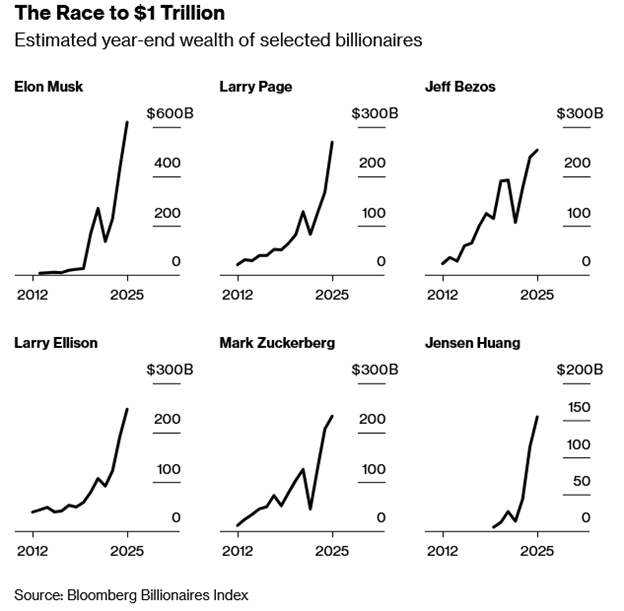
"Today’s super-wealthy can also change the world with their philanthropy," Steverman writes. "But most of the contenders for trillionaire wouldn’t need to give away a cent to affect our lives. The digital worlds where we spend more and more of our time are under their direct control. We argue and entertain ourselves on their social media platforms, and their rush toward AI has the potential to change the course of everything from our careers to the climate."
The echo of Twain's and Warner's book is more relevant than we usually acknowledge. We now live in a country plagued with open corruption, one in which the President of the United States lies constantly and with impunity, in which he and his family enrich themselves, in which a smaller and smaller group of people, many of whom endorse all this, and profit by it, control more and more of the nation's wealth, one which is, at the moment I write this, engaging in war as the Gilded Age governments engaged in colonial war.
The era Twain and Warner presaged eventually gave way to an era of increasing equality, better health, widespread education, and national prosperity. But it took a populist revolt, a Great Depression, and two World Wars to do it. This time, maybe, it can be a little easier.
Comments ()