Declaration of Independence
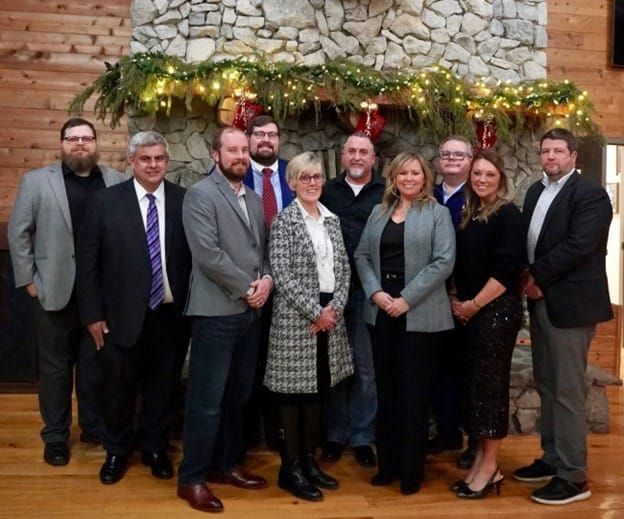
Take a look at the two women in the front row center, of the photo above. The woman with the short blonde hair is Amie Cohen. The woman standing next to her in the gray/blue jacket is Kate Smiley. They are new members of the Lancaster, Ohio City Council.
They are also revolutionaries.
Cohen, 64, works for a real estate company. Smiley, 38, works at a bank. I should also tell you that I am slightly acquainted with both of them. I grew up with Smiley's mother and remember when she was pregnant with Kate. I swam on the same swim team as Cohen. They both seem about as middle America as you can get, and they are, but they are revolutionaries just the same.
In a heavily Republican town, both won their seats by running as independents. Cohen defeated an incumbent Republican. Smiley defeated a radical right Christ-and-guns candidate. That they did so, and how they did so, makes them avatars for a national, bottom-up revolution in political parties.
Both the Republican party and the Democratic party are losing their meaning. More Americans, 41 percent, now say they are independents than say they consider themselves Republican or Democrat, as disgust with national politics and parties in the Age of Trump grows.
This week, on Monday, an El Cajon, California city councilman named Gary Kendrick announced he was leaving the Republican party to become a Democrat. Earlier this month, a state representative in Indiana, Ed Clere, left the Republican party, declared himself an independent, and said he was going to run for mayor of New Albany, Indiana. In Nebraska, Dan Osborn, who surprised a lot of people by making a good showing in an independent run for U.S. Senate against incumbent Republican Deb Fischer, is mounting another independent campaign against former governor and scion of a billionaire family, Pete Ricketts, for Ricketts' senate seat. There's a strong independent push in a Chicago congressional race, and the former mayor of Las Cruces, New Mexico, Ken Miyagishima, said he was no longer running for the state's governorship as a Democrat, but as an independent.
"I’ve been reflecting on our political scene, both in New Mexico and across the nation," Miyagishima said. "The divisions and constant fighting are holding us back from addressing the real issues we face."
Independents who buck the two parties do win, sometimes, as Bernie Sanders demonstrates, but it is true that, lacking the financial backing and party apparatchik support, they more often lose.
Cohen and Smiley, however, did not lose.
Cohen doesn't necessarily see herself as part of any revolution. She was just frustrated. "After the last election, well, I did not support Trump. I was not happy when he won, and I was frustrated in terms of 'What can I do? I can't just post to Facebook and complain.'"
As it happened, ultra-right-wing candidates won primaries for Lancaster's city council, including a young man named Ethan Dorr. Dorr, new to Lancaster, is part of a clan that has made reactionary politics pay off.
In their former home state, Iowa, the Dorrs became uncompromising gun rights activists running campaigns for cash, then migrated to form guns-and-god groups like one in Minnesota and one called Ohio Gun Owners, a perch from which they brag about "boot stomping anti-American politicians [sic] political careers in states all across our great land."
Along the way they've been accused of using the tough talk as a cover for grifting, a charge they deny. As the Cincinnati Enquirer reported, "the Dorrs have left in their wake a slew of Second Amendment advocates that accuse the brothers of lining their pockets with the money of deceived gun owners. One Iowa Republican politician called the Dorrs' operation 'a scam.'"
"I can tell you that part of the reason Kate and I both ran" was the easy primary wins of far-right candidates, Cohen explained. If those people went unchallenged they would be sure to win council seats in the general election dominated by Republican voters. Both Cohen and Smiley decided to run in an effort to prevent that.
There is a long tradition in Lancaster of candidates switching parties when they run for office. I interviewed a judge for my book Glass House who had been a long-time Democrat who re-registered as a Republican knowing he'd never win his judgeship with a "D" by his name. So Cohen, who told me she "leans left," declared her independence.
There was more to it than simple expediency, though. "I think with my friends, and I have had these conversations, they do not like either party." Friends who are Democrats are angry and frustrated with the national leadership of the party – "Oh, yeah!" Cohen exclaimed – in the face of the MAGA rampage through American democracy. Others, even some who might be more conservative, "are disgusted. The ones who are disgusted I would call a silent majority," Cohen said. "They don't post on Facebook. If they know what way you lean, you can have a conversation, but they don’t just bring it up. They don’t set themselves up for conflict."
As Cohen talked to people in Lancaster, though, she sensed possibility. She discovered that many Republicans could not stand Trump. Though she'd never run for public office aside from a long-ago seat on the local school board, and hadn't planned on running before the primary results, she decided to give it a go. "I felt like you can't run as a Democrat in Lancaster and win. There are not enough Democrats. So I felt running as an independent would give me the best opportunity to have Republicans vote for me, because I needed that. I needed Republicans to vote for me in addition to Democrats and Independents."
Besides, she said, "I feel like city business should not be party-driven. It should be what’s best for the city. It does not matter if it is left or right."
During the campaign, "my message was not left and not right. It was just Lancaster. And in the environment I was running in, post Trump, and a lot of emotions going around, that would resonate with people tired of people fighting and taking this hard line."
Smiley's opponent, Dorr, tried to make a big issue out of LGBTQ people, Christianity, guns, and eliminating taxes, but when she and Cohen knocked on doors and talked to their fellow residents, they found that people wanted to know more about street paving, and trash collection, and city fees. They didn't want their basements to flood due to poor sewer maintenance. Cohen campaigned on better communication between council and city residents, and transparency in how tax money is spent and why.
During the general election campaign, the two women, who did not know each other well, became friends. "Neither of us ran for office before. Both Kate and I would have been disappointed if the other person did not get on council. We did not run together, and we focused on different things; her ward is a bit different from mine. But we definitely met and discussed different strategies, shared resources. We helped each other."
The local Republican Party, and especially Dorr, did not take the loss well.
"The Radical Left may be cheering, but make no mistake, their celebration will be short lived," Dorr said in an unintentionally hilarious statement, demonstrating how little he knows about Smiley personally and Lancaster in general. "Kate Smiley and her friends in the downtown political establishment think they can hide their agenda behind nice slogans and fake 'independent' branding. But we all know what they stand for: higher taxes, moral decay, and the slow destruction of everything that made Lancaster great...
"We’re not backing down. We’re not going away. We’ll keep organizing, speaking out, and fighting for the families, the faith, and the freedoms that define us. And in two years, we’ll be back stronger, louder, and ready to take back what belongs to the people."
And then Dorr compared losing an election to the murder of Charlie Kirk: "The Radical Left can try to silence us, like they did Charlie, but they’ll never defeat us."
"The Republican Party was totally amazed that Kate and I won. Totally," Cohen said. Before the election, she said, "I met with both Democratic and Republican leaders to introduce myself and talk about what I wanted to do, and one guy on the Republican committee pretty much said to me 'When you lose, and if you want to run again in two years, the Republicans would like to have you on our side. Kate and I have heard that Republicans insinuated the environment we won in was unique to this past election, so when we have to run again we need to run as Republicans if we want to win again."
She laughed out loud.
Comments ()