Boots on the Ground
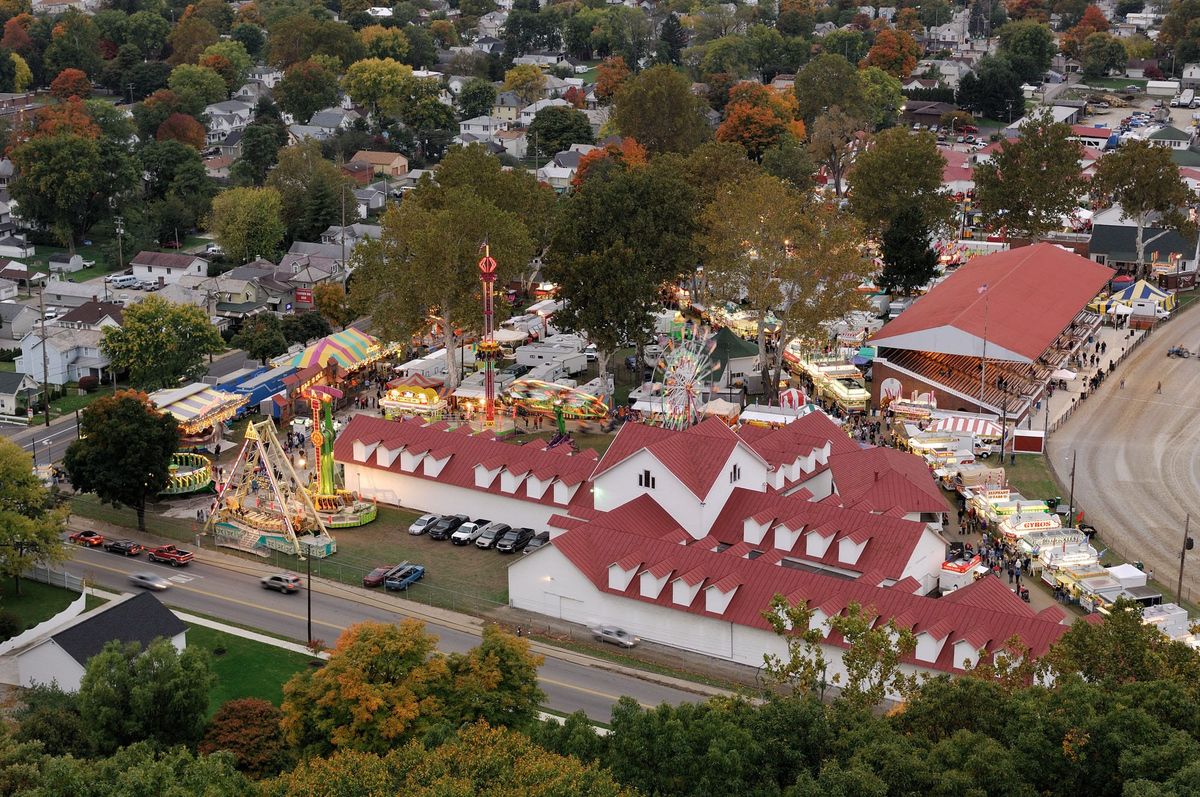
I've been thinking a lot about the noodles in the chicken noodle soup served at the Fairfield County Fair. Every year, for many, many years, the Amanda-Clearcreek schools – or, I guess, the band boosters, or the PTA, or some such school organization – have served up homemade chicken noodle soup at the fair, held every October in Lancaster, Ohio. (See that scrum of trailers behind the racetrack grandstand? Somewhere in there is where the soup happens.) The Amanda chicken noodle soup is, like the fair itself, a tradition. The fair, in fact, is the oldest continuous county fair in the state, the last county fair of every year, and the best, too. I recall one fair when a rumor spread that the noodles in the chicken noodle soup were not homemade, and this was such an insulting slur that there was great controversy about it.
The soup and the fair were brought to my mind this week by three moments. First, my friend Patrick called. He heard I was going to be in Ohio, in Columbus, for an appearance at the city's central library. Maybe he and his wife would drive down from their home in Michigan. We realized the dates didn't work, but, he said, "We've been thinking of going back for the fair in October. You want to go to the fair?"
"Yes!" I answered, and so we may well meet up on the midway in October. People from Lancaster do this. We come back from California, or Michigan, or England, or Japan to go to the fair.
There are a lot of reasons why we do this, but here's one:
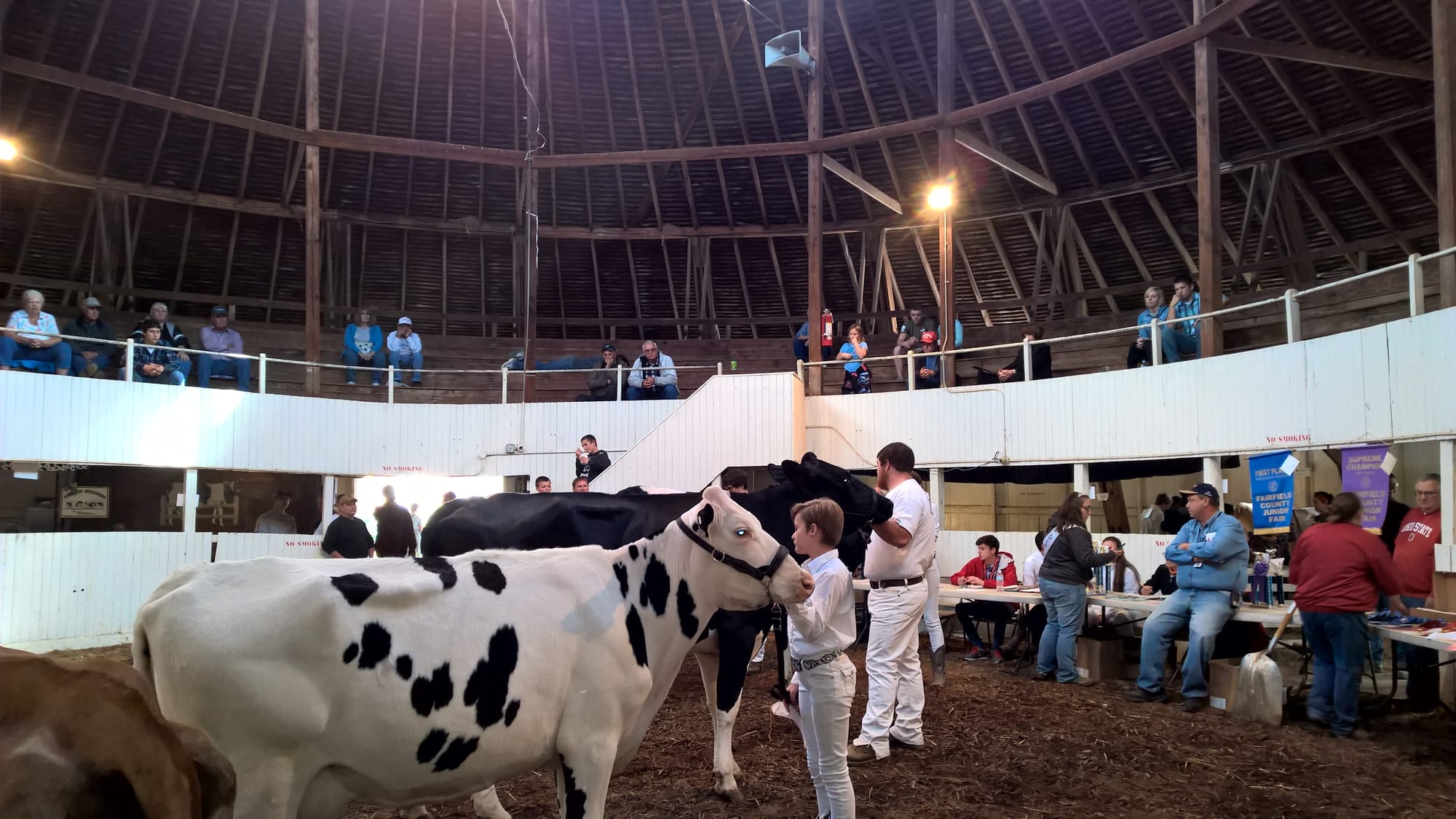
That's the 4-H cattle judging, held in the round cattle barn, an architectural landmark. (Ever see the Robert Redford movie Brubaker? There was a scene filmed in there. See the guy sitting in the stands with a light blue shirt, and a white cap? When I was in the 8th grade, I sat right there in the empty barn and kissed a girl.) The kids' cattle judging matters, just like the chicken soup matters. It's real, and its old, and therefore a constant in a world that often seems to have no constants. Both the soup and the fair are a reassurance about place, community and identity.
The second reason why the noodles came to mind this week was because I've been reading Beth Macy's book, Paper Girl, part memoir, part journalistic exploration of how this country got itself into such a dysfunctional moment. My reading is in preparation for the above mentioned appearance at the Columbus Central Library. I'll be "in conversation" with Beth on May 3. If you're in the area, you should come.
Beth grew up in Urbana, Ohio, southwest from my hometown, and while Urbana and Lancaster are different in some ways, reading Paper Girl has made me realize how similar they are, too. I'm halfway through the book. It's excellent. And I feel it in my bones because I know the people she writes about, the places she writes about, the changes she writes about. True, the particular names of the people and places are different, but I still know them. Beth is running for Congress in Virginia, where she now lives. She's turning her passion for such people and such places into action.
The third prompt for my chicken soup reverie arrived with the news that thousands of young men and women are being sent to the Middle East to prepare to fight yet another war there. Because I live in San Diego, along with thousands of U.S. Navy sailors and U.S. Marines, I often find myself sitting across an airplane aisle from young men and women – mostly young men, boys, really – heading to boot camp. They sit in their seats with their hands wrapped around manila envelopes that contain their orders, their eyes often staring straight ahead at the back of the seat in front of them, their hair already cut high-n-tight by their local barber, the skin around their scalps paler than the rest of their faces for the newness of the cut. If they have a window seat, they stare out the window. Sometimes they ask me questions about where we are at that moment, or what San Diego is like, or if it's true that California has pretty girls. Some of them have never been on an airplane before. Most of them have never been so far from home.
One once asked me, "You ride?" meaning motorcycles.
"Yeah," I said.
"First thing, I'm gonna buy me a Jixser!" he said, referring to a Suzuki GSX-R, a high-powered street motorcycle. I worried about him, like I worry about the young Americans being sent overseas right now. They should be home, going to fairs, eating chicken noodle soup, flirting in the stands of a show barn.
I imagined the boy in the foreground of the cattle judging photo as one of those young men on a plane. That image was taken in 2016, so he'd be the perfect age, now, to have joined the military, which is what a lot of kids from Lancaster and Urbana do.
He should not be a "boot on the ground," a dumbass cliche I consider a crime against language, and a crime against every one of those young people. We've become so militarized and used to military-speak – our sunglasses are now "tactical" – that we turn kids like that boy holding his cow into anonymous "boots on the ground."
Of course, the boy in the photo could be a farmer, now. Maybe he went to college and is working as an accountant. I don't know what he did or where he is. But thousands of young men and women just like him, from places just like Lancaster and Urbana, are right now sitting on transport planes, not clutching their orders in manila envelopes and thinking about girls and motorcycles, but holding gear for killing and thinking about whether they will have to kill or be killed. They are on their way to an illegal, unnecessary war fueled by incompetence and hubris. They are not boots. They are people, every one a solid gold coin of humanness and value, far too wastefully spent to satisfy the whims of one man.
Comments ()