Bend Over and Open Wide
Musk is an obvious threat to our democracy, but Schmidt and the rest are, too, because they are traitors to the idea of America, the only country founded as an idea.
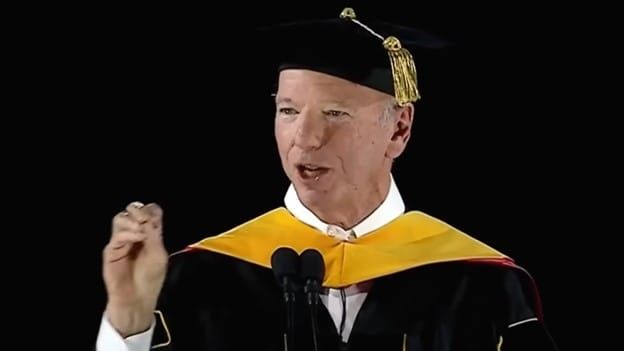
Eric Schmidt, the former CEO of Google, isn't used to being booed. Nobody boos him at Davos, or in the fancier bistros of Montecito where he owns a mansion, or in London, where he owns another mansion, or in Los Angeles, where he owns mansions – plural – or in New York where he owns a mansion, or in Miami where he owns a couple of mansions, or in Georgetown where he owns a mansion, or his gigantic yacht, a mansion that floats, but the students graduating from Arizona State last Sunday gave Schmidt the raspberry treatment when he spoke to them about the AI steamroller fueled by, among others, Google. Or Alphabet. Or whatever the hell it's calling itself now.
"There is a fear in your generation that the future has already been written," Schmidt said, accurately. "The machines are coming...the jobs are evaporating...the climate is breaking...politics is fractured...you are inheriting a mess that you did not create. And I understand that fear. It’s rational... ." That sounds reasonable enough, but then mansion-collector Schmidt said, essentially, "suck it up."
"We do not know the precise contours of what this transformation will look like, but what we do know is it will require each of us to adapt in ways that we cannot yet anticipate... . When someone offers you a seat on the rocket ship, you do not ask which seat. You just get on. The rocket ship is here.”
Do not, Schmidt seemed to be saying, question the premise of the Silicon Valley oligarchy's profit-motivated juggernaut that supplied all that dough for all those mansions and will free Schmidt from ever having to use AI. Everybody else will have to adapt to its desires or die.
People just love that sort of choice, especially in a democracy that imagines itself to be the world's bastion of personal liberty, a country founded by farmers and tradesmen out of the blood and fire of revolution.
Schmidt walked blindly into a new revolution he doesn't understand. It's going on right now. Schmidt, Sam Altman, Musk, Andreessen, Bezos, Thiel, and all the rest want you to think that it's the AI revolution, following on the heels of the digital revolution of the 1980s and 1990s, but, as Schmidt's cluelessness demonstrates, this belief is a display of astounding ignorance among a class of people who want us to believe they are super smart. But like the students at Arizona State, Americans have had enough. We've had enough of the most egregious inequality in our history, enough of domination by ever-more concentrated corporations, enough of the manipulation of our politics by the richest people in the world, enough of the politicians bought off by all that money.
And when the revolution really begins to roll, Schmidt and his ilk are going to hear a lot more than boos.
Musk is an obvious threat to our democracy, but Schmidt and the rest are, too, because they are traitors to the idea of America, the only country founded as an idea.
In late 2011, the Nobel-prize-winning economist Daron Acemoglu wrote an essay with his fellow Nobelist James A. Robinson: "Is This Time Different? Capture and Anti-Capture of US Politics." In it, they argued that what made the United States such a successful country, both materially and politically, were the ideals upon which the nation was founded.
"The US case in fact illustrates a more general principle. Countries which have created egalitarian, economically dynamic societies have done so because they have forged inclusive political institutions which then led to inclusive economic institutions...
"In fact the inclusive nature of political institutions and economic institutions feed
on each other. Broadly distributed political power led to inclusive economic institutions which spread opportunities, income and wealth more equitably. This in turn helped sustain the broad distribution of political power as economic resources and power beget political power."
This dynamic, they explained, has been challenged throughout American history. Slave states, which became Jim Crow states after Reconstruction was abandoned, suffered economically because the political institutions favored a small wealthy class, like plantation owners, at the expense of both poor whites and the enslaved, and then poor, Blacks. To this day, Alabama, Mississippi, Louisiana, Arkansas are among the poorest states in the nation.
The Gilded Age, with the rise of monopoly, cartels, "trusts," and robber barons presented another challenge. "The wealth of the Robber Barons was created by their ability to take advantage of many new economic opportunities that emerged, often generated by new technologies like railroads," Acemoglu and Robinson wrote. "But these men also quickly became adept at using this wealth to manipulate the political system to their advantage, a sort of inequality multiplier. Crucially, the Robber Barons captured the Senate, which was indirectly elected by state legislatures." A famous article in a 1906 issue of Cosmopolitan (a little different than the version of Cosmo we know today), by journalist David Graham Phillips was titled "The Treason of the Senate."
Treason.
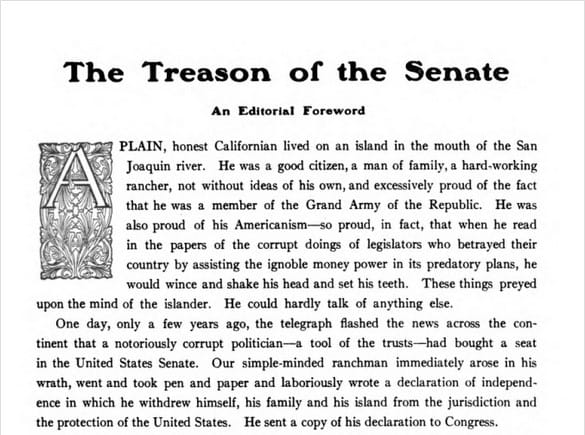
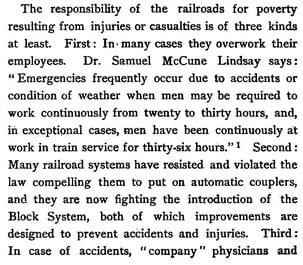
In his 1905 book, "Poverty," sociologist Robert Hunter concluded that one percent of the families in the U.S. held more property than the remaining 99 percent. (Sound familiar?) That one percent, Phillips showed, controlled the U.S. Senate. The corporations, like the technological champions of the time – the railroads – ran roughshod over the working class, Hunter found, and they could do so knowing that the government wouldn't stop them.
If you have any doubt that the exact same dynamic is alive and well in Trump's America, consider this week's excellent reporting about how Reynolds American, the tobacco giant, gave $5 million to MAGA Inc., Trump's super PAC, then sent a Reynolds executive and two of the company's lobbyists to lunch with Trump in Florida, whereupon the FDA revisited its ban on fruit-flavored vapes – nicotine delivery devices – that once attracted lots of kids. (The White House, of course, denied any link between the donation and the new policy.) If that's not good enough for you, consider the booming presidential pardon business. In the Middle Ages, that was the sort of thing – selling Indulgences – that led to the revolution of the Reformation.
Corruption is treason. It took a revolution to combat the treasonous power of Gilded Age wealth, and, as Acemoglu and Robinson point out, that revolution came from common people like members of Grange organizations, the populists, the progressives, the labor movement. Last month, in my post The Paramount Concern (paywalled), I mentioned Wendell Berge, a New Deal Justice Department lawyer who made anti-trust his special focus. Berge was born and raised in Lincoln, Nebraska. His father, George, was a local newspaper editor and owner, friend of William Jennings Bryan, and very nearly the governor of Nebraska. George was active in the early "People's Party." Its 1892 "Omaha Platform" called out the obvious: "The fruits of the toil of millions are boldly stolen to build up colossal fortunes for a few and the possessors of those, in turn, despise the republic and endanger liberty."
These people saw the link between savage inequality and the fate of their democracy.
Reform movements and Theodore Roosevelt's trust busting helped restore a little balance, but it wasn't until the New Deal that corporate power and the power of wealth felt the lash of the people's reins. Just as the Silicon Valley oligarchs are fighting any regulation – and just as the railroads fought any regulation back in 1905 – the super wealthy of the 1930s, like the Mellons, the DuPonts, the Baldwins, the Vanderbilts, the Rockefellers believed FDR was a traitor to his class, and a fatal threat to them. The Republican Party has been motivated by that hatred ever since. What we see with Trump's party now is directly connected to the nearly century-long lust to roll back the New Deal.
Wendell Berge, on the other hand, saw the big picture the way other New Dealers saw it. He made the important connection. "The problem of the have-nots is not merely a humanitarian or charitable problem," he said in a February, 1941 speech. "It is inextricably connected with the preservation of the essentials of capitalism and democracy."
America, not yet in World War II, witnessed what was happening in Europe with the rise of totalitarianism and the power of corporate concentration. They were two sides of the same coin.
Today, we are told to submit, that there is no resisting the power of a few gigantic companies. Our own government is ceding powers to them. Trump demands flattery, receives it, and then concedes the people's power to Palantir, Alphabet, Microsoft, Apple, Amazon, the crypto bros, the chip makers, the AI religionists.
"I’m comparing him to his first term, and I think he is a more mature, more disciplined version of himself than he was in his first term,” Bezos told Andrew Ross Sorkin during a CNBC interview this week. Bezos said Trump "has lots of good ideas."
Bezos isn't an idiot, just a cynic. He knows better. He doesn't care. He doesn't care about this country, about the men and women resting in graves at Brandywine, Shiloh, Normandy, Arlington, because he is happy to sell this nation's ideals.
These people care nothing for what came before. They care nothing for the nation that allowed their tremendous wealth to accumulate, and, paradoxically, they are wrecking capitalism on their way to the Met Gala. We are told we cannot regulate them nor tax them fairly because then we'd kill the goose that is laying our golden eggs. (I have been told to forget about the fact that Anthropic stole four of my books, that Mark Zuckerberg stole my books, because that's the price of the miracle of AI.) But the students listening to Eric Schmidt didn't think those eggs were so golden, nor that the miracle was so welcome. A lot of people don't. We are awakening to the realization that, like the railroad barons of a by-gone age, the oligarchs will roll over all of us if we don't act.
Patriotism demands participation. Fighting the treason of Schmidt, Bezos, Musk, and the rest, will call for more than booing, though that's a fun start; humiliating a billionaire feels pretty good. So thanks, Arizona students. Now, let's get on with the revolution.
P.S.
Consider this my Memorial Day post. This weekend I'll be treating myself to a gimlet, and will be thinking about what came before, the memory of Memorial Day. I hope all of you can find a few happy moments this weekend. Thanks for reading.
Comments ()